ResearchMonday, April 20, 2026

AI-Powered Supply Chain Risk Intelligence: The $50B Opportunity in Autonomous Logistics

Global supply chains face unprecedented disruption risk. From geopolitical tensions to climate events, companies lose $184 million annually on average to supply chain disruptions. Loop just raised $95M to predict these disruptions before they strike—proving AI agents can transform reactive logistics into autonomous, self-healing systems.

1.

Executive Summary

Supply chain risk management is undergoing a fundamental transformation. For decades, companies have relied on reactive approaches—monitoring spreadsheets, responding to delays after they occur, and manually coordinating with suppliers. The result: $184 million in average annual losses per company due to supply chain disruptions (BCI Global Resilience Report).

A new category is emerging: AI-powered supply chain risk intelligence platforms that don't just track issues—they predict, preempt, and autonomously act. Loop's $95 million Series C (April 2026) validates this thesis, with investors including 8VC, Founders Fund, Index Ventures, and J.P. Morgan's Growth Equity Partners betting on this future.

This article explores the opportunity to build verticalized AI agent platforms for supply chain risk management—focusing on India's manufacturing exporters, logistics companies, and the $500B+ global market for autonomous supply chain resilience.

2.

Problem Statement

The Supply Chain Visibility Crisis

Global supply chains are more volatile than ever:

  • Geopolitical risks: Trade wars, regional conflicts, and policy shifts disrupt established routes
  • Climate events: Extreme weather causes 35% of all supply chain disruptions
  • Supplier failures: 60% of companies experienced at least one supplier disruption in 2025
  • Demand volatility: Consumer behavior shifts faster than supply chains can adapt
Yet 87% of companies lack real-time visibility into their Tier 2+ suppliers. They operate in darkness until problems land on their doorstep.

Current Pain Points

Pain PointImpactCurrent "Solution"
Manual tracking15-20 hours/week per procurement managerSpreadsheets, email chains
Reactive response3-7 day delay in addressing issuesFirefighting after damage
Siloed dataNo unified view across suppliersMultiple disconnected systems
No predictive capabilityBlind to risks until they materializeHistorical averages, intuition
Slow mitigationWeeks to find alternative suppliersAd-hoc supplier searches

The India Opportunity

India's manufacturing sector is experiencing a golden period:

  • $1 trillion manufacturing GDP target by 2025-26
  • PLI schemes worth $26B+ driving electronics, pharma, auto components
  • Export growth: $400B+ annual exports, growing 10%+ YoY
  • E-commerce boom: $350B market creating massive logistics demand
Yet Indian exporters face unique risks:
  • Port congestion at JNPT, Nhava Sheva, Chennai
  • Customs delays due to documentation errors
  • Currency volatility impacting margins
  • Fragmented supplier networks with limited visibility
The market gap: No Indian startup has built an AI-native supply chain risk platform. Existing solutions are either global tools (too expensive, not India-optimized) or basic tracking software (no AI, no predictive capability).


3.

Current Solutions

Global Players

CompanyWhat They DoLimitations
LoopUnstructured data → structured intelligence, predictive riskEnterprise-focused, US-centric, expensive
Uber FreightDigital freight matching, some AI pricingFocuses on carriers, not comprehensive risk
FlexportEnd-to-end logistics, AI toolsStruggling post-founding issues, enterprise focus
FourKitesReal-time visibility, some MLHeavy implementation, not agentic
project44Supply chain visibilityReactive, not predictive

Indian Market

CompanyFocusGap
RivigoTrucking, some predictiveNot comprehensive risk, B2C focus
LocusRoute optimizationNot supply chain risk
FarEyeDelivery managementLast-mile focus
Freight TigerFreight bookingTransactional, not risk

Key Insight

No company currently offers autonomous AI agents that:
  • Continuously monitor multi-source risk signals
  • Predict disruptions before they occur
  • Automatically execute mitigation actions (rerouting, supplier switching, inventory repositioning)
  • This is the agentic supply chain opportunity.


    4.

    Market Opportunity

    Global Market Size

    • Supply chain management software: $22B (2025)
    • Supply chain risk management: $3.2B (2025), growing 15% CAGR
    • AI in supply chain: $9.5B (2025), growing 45% CAGR
    • Total addressable market: $50B+ by 2030

    Indian Market

    • Logistics market: $350B (2025)
    • Supply chain software: $1.2B, growing 25% CAGR
    • Manufacturing exporters: 300,000+ companies
    • E-commerce players: 500+ large GMV companies

    Why Now

  • LLM breakthrough: Can now process unstructured data (PDFs, emails, messages) that was previously impossible
  • Multi-agent systems: Can orchestrate complex workflows across suppliers, carriers, warehouses
  • Real-time data availability: More APIs, more connected systems, more signals than ever
  • Customer desperation: Post-COVID disruption fatigue; companies are paying for resilience
  • Proven playbook: Loop's $95M raise validates the thesis; investors are looking for category leaders

  • 5.

    Gaps in the Market

    Gap 1: No Agentic Layer

    Current tools are passive dashboards. They show data but don't act. The next generation must have autonomous agents that:
    • Detect risk → Analyze options → Execute mitigation → Report outcomes

    Gap 2: Tier 2+ Supplier Blindness

    Most companies see only their direct suppliers. Risk originates deep in the supply chain:
    • Sub-supplier failures (e.g., a component manufacturer in China)
    • Geopolitical exposure (suppliers in conflict zones)
    • Financial distress (supplier bankruptcy risk)

    Gap 3: India-Localized Data

    No platform has built:
    • Indian port congestion prediction
    • Customs delay forecasting based on document patterns
    • India-specific risk signals (monsoon impacts, state-level policy changes)
    • Integration with Indian systems (GSTN, ICEGATE, port APIs)

    Gap 4: Verticalization

    Generalist platforms try to be everything. Vertical AI agents can go deeper:
    • Pharma cold chain risk (temperature excursions, regulatory)
    • Auto components risk (just-in-time supplier failures)
    • Electronics risk (component shortages, yield issues)
    • Agri-exports risk (quality, weather, cold chain)

    Gap 5: SMB Accessibility

    Current solutions cost $100K+ annually. Indian SMBs (80% of manufacturing) cannot afford enterprise tools. A self-serve, usage-based pricing model could capture this massive market.
    6.

    AI Disruption Angle

    The Agentic Supply Chain

    Traditional supply chain management is deterministic: inputs → processes → outputs.

    Agentic supply chain is probabilistic: agents perceive → reason → act → learn.
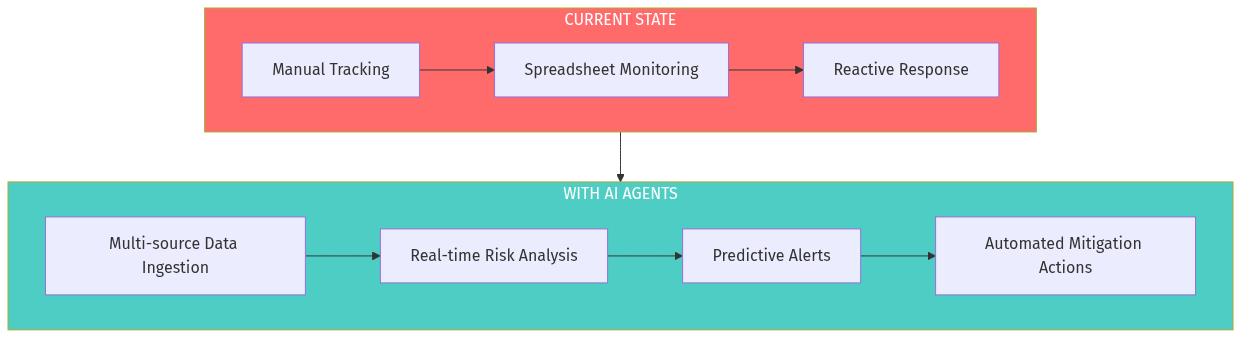
    Supply Chain Risk Intelligence Architecture
    Supply Chain Risk Intelligence Architecture

    How AI Agents Transform the Workflow

    #### Today (Manual/Reactive)

  • Procurement manager checks email for delay notifications
  • Searches for alternative suppliers (manual Google/directory)
  • Contacts suppliers, negotiates, places emergency order
  • Tracks shipment, hopes for best
  • Time to mitigation: 5-7 days average

    #### Tomorrow (Agentic/Autonomous)

  • AI agent monitors 50+ risk signals in real-time (news, shipping data, supplier APIs, weather, financial)
  • Detects pattern: "Component X supplier in Thailand showing delayed payments + weather alert → 80% chance of disruption in 14 days"
  • Auto-searches approved supplier alternatives, evaluates pricing/lead time
  • Presents recommendation to human or auto-executes based on risk level
  • Continuously monitors, adapts strategy
  • Time to mitigation: Hours (or instantaneous for pre-approved scenarios)

    Key AI Capabilities

    CapabilityTechnologyImpact
    Unstructured data parsingLLM + OCRTransform PDFs, emails, messages into structured data
    Risk signal correlationMulti-modal MLConnect dots across disparate sources
    Predictive modelingTime-series + causal AIForecast disruptions 2-4 weeks ahead
    Decision automationAgentic workflowsExecute mitigation without human delay
    Natural language interfacesConversational AILet managers query supply chain in plain English
    ---
    7.

    Product Concept

    Core Product: SupplyChain.ai (or similar name)

    MVP Features:
  • Risk Dashboard
  • - Single pane of glass showing all supply chain risks - Risk scores by supplier, region, category - Alert prioritization
  • Supplier Intelligence
  • - Automated monitoring of supplier health (news, financial, operational) - Tier 2+ visibility (via network effects) - Alternative supplier recommendations
  • Disruption Prediction
  • - Port congestion forecasting - Weather impact analysis - Geopolitical risk monitoring
  • AI Agent Actions
  • - Automated alert routing - Alternative supplier discovery - Contract/PO automation (future)

    Platform Architecture

    ┌─────────────────────────────────────────────────────────────┐
    │                    SupplyChain.ai Platform                  │
    ├─────────────────────────────────────────────────────────────┤
    │  DATA LAYER                                                  │
    │  ├── Supplier APIs (SAP, ERPs, customs)                     │
    │  ├── Logistics APIs (shipping, tracking)                    │
    │  ├── External Signals (news, weather, financial)            │
    │  └── Internal Data (orders, inventory, contracts)           │
    ├─────────────────────────────────────────────────────────────┤
    │  INTELLIGENCE LAYER                                         │
    │  ├── Risk Engine (ML models, scoring)                       │
    │  ├── LLM Pipeline (unstructured → structured)               │
    │  ├── Prediction Models (time-series, causal)                │
    │  └── Agentic Framework (plan, execute, learn)               │
    ├─────────────────────────────────────────────────────────────┤
    │  AGENT LAYER                                                │
    │  ├── Monitor Agent (24/7 signal tracking)                   │
    │  ├── Analyze Agent (root cause, impact assessment)          │
    │  ├── Recommend Agent (alternative actions)                  │
    │  └── Act Agent (automated workflows)                        │
    ├─────────────────────────────────────────────────────────────┤
    │  INTERFACE LAYER                                            │
    │  ├── Dashboard (web + mobile)                               │
    │  ├── API (integration for enterprise)                       │
    │  └── Chat Interface (conversational)                        │
    └─────────────────────────────────────────────────────────────┘

    8.

    Development Plan

    Phase 1: MVP (3 months)

    FeatureTimelineDeliverable
    Risk dashboard setupMonth 1Web dashboard with supplier input
    Supplier monitoringMonth 2Automated news + financial monitoring
    Integration (3PL)Month 3API connections to 3 major logistics providers
    Basic alertsMonth 3Email + Slack notifications
    Investment: $150K-250K Target users: Mid-market manufacturers (₹50-500Cr revenue)

    Phase 2: V1 (6 months)

    FeatureTimelineDeliverable
    Predictive modelsMonths 4-5ML models for port/congestion prediction
    Agentic actionsMonths 5-6Automated alternative supplier search
    API platformMonth 6Public API for ERP integration
    Mobile appMonth 6iOS + Android apps
    Investment: $500K-1M Target users: Large enterprises, exporters

    Phase 3: Scale (12 months)

    FeatureTimelineDeliverable
    Vertical modulesMonths 7-12Pharma, auto, electronics specializations
    Global expansionMonths 10-12SEA, Middle East exporters
    Agent marketplaceMonth 12Third-party agent ecosystem
    Investment: $2-5M Revenue target: $2-5M ARR
    9.

    Go-To-Market Strategy

    1. Founder-Led Sales (Months 1-6)

    • Target: 20 manufacturing exporters via personal network
    • Focus: NCR, Mumbai, Bangalore manufacturing clusters
    • Offer: Free pilot → Paid (if value proven)

    2. Vertical Focus (Months 6-12)

    • Pick 1-2 verticals (e.g., pharma exports, auto components)
    • Deep dive: understand workflows, pain points, buyer personas
    • Build vertical-specific AI agents

    3. Network Effects (Year 2+)

    • Supplier network: As more buyers join, they share supplier risk data
    • Risk intelligence: More data → better predictions (flywheel)
    • Marketplace: Connect buyers with verified alternative suppliers

    4. Pricing Model

    TierPriceFeatures
    Starter₹15K/month5 suppliers, basic monitoring
    Growth₹50K/month25 suppliers, predictions, alerts
    Enterprise₹2L+/monthUnlimited, API, dedicated agent

    5. Channels

    • Industry events: India Logistics Summit, Manufacturing Summit
    • Trade associations: CII, FICCI, export promotion councils
    • Partner channel: 3PLs, customs brokers, freight forwarders
    • Content marketing: LinkedIn, trade publications

    10.

    Revenue Model

    Primary Revenue Streams

  • Subscription Revenue (70% of revenue)
  • - SaaS subscriptions (monthly/annual) - Usage-based pricing for API calls, agent actions
  • Transaction Revenue (20% of revenue)
  • - Alternative supplier discovery fee (commission) - Emergency procurement facilitation
  • Data/Intelligence Revenue (10% of revenue)
  • - anonymized market intelligence reports - Benchmarking data (industry-level, privacy-protected)

    Unit Economics

    MetricTarget
    CAC₹3-5L per customer
    LTV₹15-25L (3-5 year relationship)
    LTV:CAC5:1
    Gross margin70-80% (software, not services)
    Payback period12-18 months
    ---
    11.

    Data Moat Potential

    Proprietary Data Assets

  • Supplier Health Database
  • - Unique dataset of supplier financial + operational health - Improves with every customer (network effect)
  • Risk Signal Library
  • - Curated, weighted risk indicators - Trained on Indian supply chain nuances
  • Disruption Patterns
  • - Historical disruption events + outcomes - Predictive model training data
  • Supplier Network Graph
  • - Relationships between buyers, suppliers, sub-suppliers - Extremely difficult for competitors to replicate

    Defensibility

    • Network effects: More buyers → better intelligence → more buyers
    • Vertical specialization: Deep workflows in pharma/auto create switching costs
    • Data flywheel: Continuous learning improves predictions over time
    • Integration depth: Deep ERP/3PL integrations are hard to unseat

    12.

    Why This Fits AIM Ecosystem

    Strategic Alignment

    This opportunity directly aligns with AIM.in's vision:

  • B2B Focus: Targets manufacturing exporters, logistics companies—core B2B
  • AI-Native: Built on LLMs and agentic frameworks from day one
  • Marketplace Dynamics: Connects buyers with suppliers (transaction potential)
  • India-First: Localized for Indian market, but scalable globally
  • Data Moat: Improves with scale—compound competitive advantage
  • Integration Points

    • Domain portfolio: Could use domains like supplychain.ai, logisticsai.in, riskintelligence.in
    • dives.in: This research validates the opportunity; can publish market reports
    • AIM.in verticals: Could become a vertical under AIM's B2B marketplace umbrella
    • WhatsApp integration: Alert Indian users via WhatsApp (our strength)

    Comparable Examples

    CompanyCategoryValuationNote
    FourKitesSupply chain visibility$1.3BReal-time tracking
    project44Supply chain visibility$1.2BEnterprise focus
    Seven SeasMaritime intelligence$500MNiche risk
    WindwardMaritime AI$300MShipping risk
    Indian winner in this space could be worth $500M-1B in 5-7 years.

    ## Verdict

    Opportunity Score: 8.5/10

    Strengths:
    • Clear market need (companies losing $184M/year on average)
    • Proven thesis (Loop's $95M raise validates AI supply chain)
    • India gap (no local AI-native competitor)
    • Strong moat potential (network effects, data)
    • Multiple revenue streams (subscription + transactions)
    Risks:
    • Enterprise sales cycles are long (6-12 months)
    • Requires significant capital to scale
    • Large players (Uber Freight, Flexport) could expand
    • Technical complexity (multi-system integration)
    Recommendation: Build. This is a $50B global market with zero Indian competition. The AI agent paradigm shift creates a real window for a new entrant. Focus on mid-market exporters first (faster sales cycles), then move up-market. Pick one vertical (pharma or auto components) to differentiate and deepen.

    The key differentiator: not just dashboards, but autonomous agents that act. Loop proved the market; India needs its own version.


    ## Sources