Reverse auction procurement platforms are transforming how manufacturing companies source raw materials and components. Unlike traditional RFQs that take days, reverse auctions compress negotiation from days to minutes. Yet in India, this mechanism remains largely manual or operated through expensive intermediaries. AI agents can now automate the entire reverse auction lifecycle: supplier discovery, verification, auction management, and contract award—making procurement transparent, faster, and 20-30% cheaper.
1.
Executive Summary
2.
Problem Statement
The Current State:
- Indian manufacturing SMEs spend 15-25% of revenue on procurement inefficiencies
- RFQ processes take 7-21 days on average
- Supplier verification is manual and inconsistent
- Collusion between known suppliers is rampant
- No real-time market pricing intelligence
- Mid-size manufacturing firms (50-500 employees)
- OEM suppliers needing components
- Construction and infrastructure companies
- Fabrication shops
3.
Current Solutions
| Company | What They Do | Why They're Not Solving It |
|---|---|---|
| IndiaMART | B2B listings, RFQs | Not real-time auction, lead-generation model |
| TradeIndia | B2B catalog | No auction capability, passive listings |
| Udaan | B2B wholesale | Closed network, inventory-based |
| Global Sources | International B2B | Not India-focused, high-ticket |
4.
Market Opportunity
- Market Size: 5B India manufacturing procurement market
- Addressable Segment: 5-20B (mid-size manufacturers)
- Growth: 12% CAGR in B2B e-procurement
- Why Now:
5.
Gaps in the Market
6.
AI Disruption Angle
How AI Transforms Procurement:
Auto-discovery: AI crawls supplier databases, identifies matches based on specs
Real-time verification:
- Credit scores via Bureau APIs
- Quality ratings via past reviews
- Capacity assessment via historical delivery data
Bid moderation: AI detects abnormal patterns (collusion signals)
Smart ranking: Multi-factor scoring (price + quality + delivery + trust)
Contract generation: Auto-draft PO based on auction outcome
The Future:
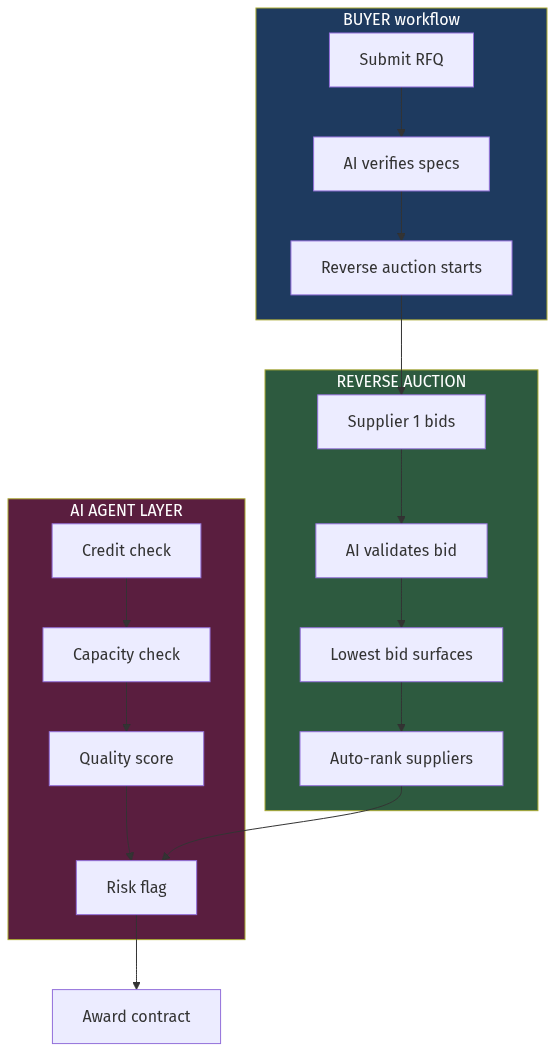
- Buyer submits specs → AI agent runs auction → AI agent awards → Contract auto-generated
- Human oversight only for exceptions
7.
Product Concept
Platform: AuctionIQ
Core Features:
Workflow:
| Feature | Description |
|---|---|
| RFQ Submission | Structured form with specs, quantity, timeline |
| AI Supplier Matching | Auto-find and invite qualified suppliers |
| Live Reverse Auction | Real-time bidding with countdown |
| AI Moderation | Collusion detection, bid validation |
| Smart Award | Multi-factor winner selection |
| Contract Suite | Auto-generated PO, terms, milestones |
8.
Development Plan
| Phase | Timeline | Deliverables |
|---|---|---|
| MVP | 6 weeks | RFQ form, basic supplier matching, sequential bids |
| V1 | 4 weeks | Live auction, auto-rank |
| V2 | 4 weeks | AI verification, collusion detection |
| V3 | 4 weeks | Contract generation, escrow |
9.
Go-To-Market Strategy
10.
Revenue Model
- Transaction Fee: 1-2% on auction value
- Subscription: Premium features (AI verification, escrow) - ₹10K-50K/month
- Premium Placement: Featured suppliers - ₹5K/month
- Data API: Market pricing intelligence - ₹25K/month
- ₹5L average auction value → ₹5K-10K fee
- Target: 100 auctions/month by month 6
11.
Data Moat Potential
- Transaction history: Real-time pricing data across categories
- Supplier intelligence: Quality, delivery, credit profiles
- Buyer behavior: Historical patterns, negotiation thresholds
- Market intelligence: Invisible to competitors
12.
Why This Fits AIM Ecosystem
This aligns with AIM's B2B discovery mission:
- Vertical fit: Procurement is a core B2B workflow
- Data accumulation: Each transaction improves AI models
- Network effects: More buyers → more suppliers → more buyers
- WhatsApp integration: Natural supplier outreach channel
- Materials marketplace
- Quality certification marketplace
- Logistics auction
## Verdict
Opportunity Score: 8/10 Rationale:- Clear problem: 15-25% procurement inefficiency
- Proven mechanism: Reverse auctions work globally
- AI native: AI enables verification and moderation at scale
- India timing: UPI + WhatsApp + manufacturing growth
- Defensibility: Data moat compounds over time
- Trust building: New platform, low awareness
- Supplier adoption: Requires network effect
- Collusion detection: AI model accuracy
## Sources
- IndiaMART Company Research
- TrustMRR B2B Revenue Data
- Y Combinator Procurement Trends
- B2B E-Procurement Market Reports
## Diagram
❧